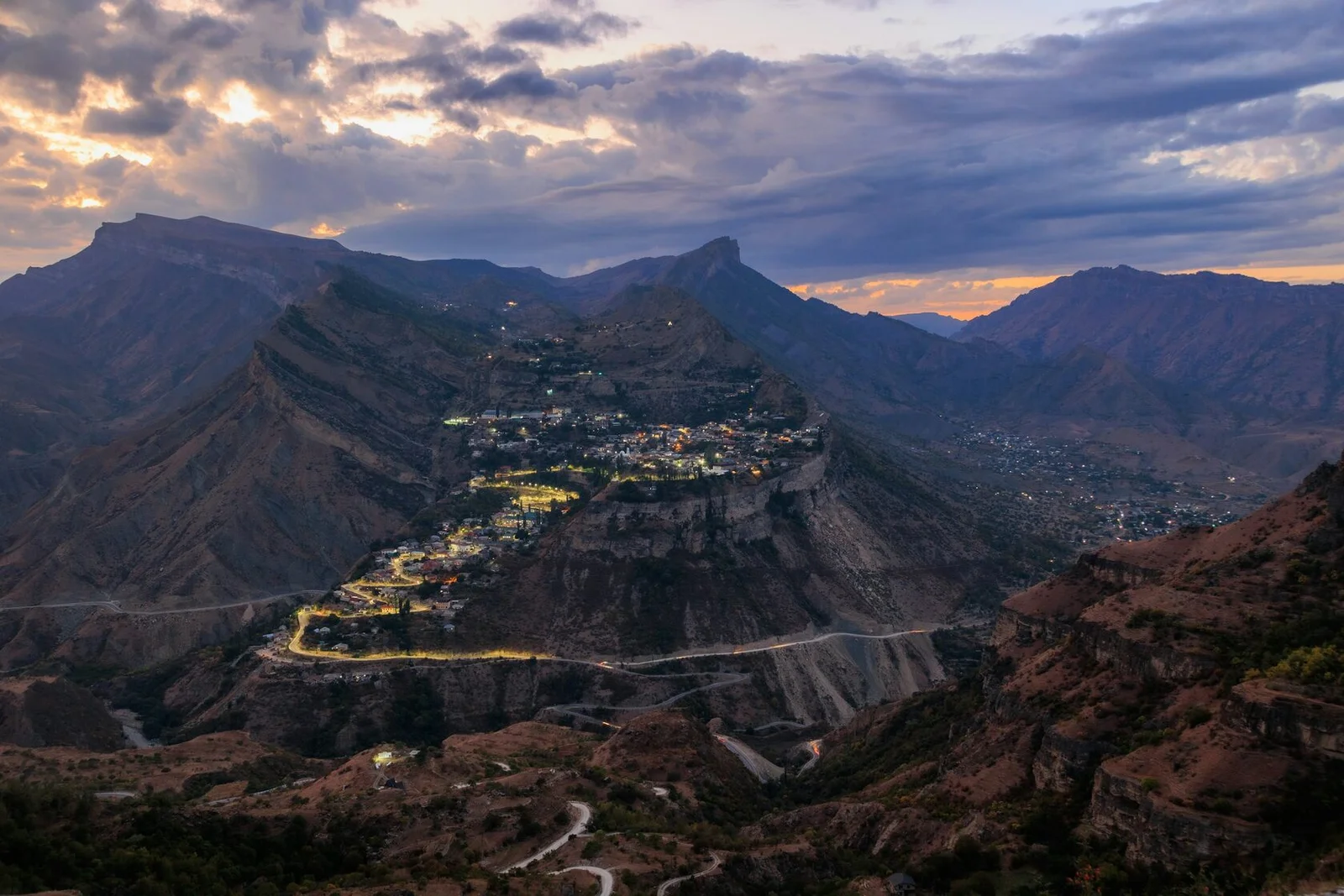

dramatic peaks at dusk.
Imagine a place where two ancient villages, separated by mere miles,
speak languages so distinct they seem worlds apart. Now, expand this
imaginary landscape to the size of Switzerland — a region teeming with
thousands of villages, each contributing to a mosaic of 35 languages. This
is no stretch for a modern literature lover steeped in the magical
realism of Borges and Marquez. Yet, strangely, this place isn’t nestled
between Narnia and Asgarda. It’s real, it’s tangible, and it exists on our
planetary mothership called Earth.
In the vertical fortress of the Caucasus, where mountains do not roll
but shatter the sky into jagged peaks and isolated gorges, a human
experiment of stunning complexity has endured for millennia. This is
Dagestan, a republic the size of Switzerland that is not a nation of one
people, but a living museum, a breathing archive, and a startlingly
successful blueprint for a society built not on uniformity, but on
orchestrated difference.
Its name translates simply to “Land of the Mountains.” But this is a
profound understatement. The mountains are not just a backdrop; they are
the original architects, the great isolators and protectors. They carved
the land into a labyrinth of remote valleys where distinct languages,
laws, and lifeways crystallized in profound solitude. This is a place
where driving twenty miles can mean crossing a border into a different
linguistic universe, where over 30 ethnic groups speaking languages from
three completely unrelated linguistic families Caucasian, Turkic, and
Indo-European have not only coexisted but woven themselves into a
cohesive social fabric.
For a world relentlessly smoothing edges into a bland global sameness,
or fracturing into polarized identities, Dagestan presents a powerful,
living counter-narrative. It is a testament to the “Mosaic Principle”: the
idea that true strength and unity are found not in erasing distinction,
but in arranging unique pieces into a shared, magnificent whole. This is
the story of how geography wrote the first draft of diversity, how history
tested it with fire and sword, and how an unlikely, subtle force — the
Russian language and culture — became the non-destructive glue that holds
this unparalleled human mosaic together.
A Vertical World
To understand the ‘how’ of Dagestan, one must first feel the ‘where.’
This is a vertical world.
Its villages are not hamlets on a plain but auls — fortified stone
settlements clinging to cliffsides like swallows’ nests, reachable only by
serpentine paths. The air in the high plateaus is thin, the soil
stubborn, the winters long. Life here demanded not just community, but
autarky and extreme resilience. In the gorge of the Avar Koysu River, an
Avar blacksmith developed a style of weaponry unknown to the Dargin weaver
in the next valley over, separated by a seemingly insurmountable ridge.
Each group became its own master of survival, developing a unique material
culture: the filigree silver of Kubachi, the indomitable wool carpets of
the Tabasarans, the distinctive felt cloaks of the highland shepherds.
This rugged geography made conquest logistically nightmarish but also
turned Dagestan into a crossroads of empires. For centuries, it lay in the
path of the world’s great expansionist forces: the Persians brought
Zoroastrian fire temples, the Arabs introduced Islam which took deep root,
the Mongol hordes swept through, the Ottoman Turks extended their
influence, and finally, the Russian Empire pushed south. Each wave left a
layer — a faith, a loanword, an architectural detail in the ancient city
of Derbent, which boasts a Persian fortress, Arab mosques, and Russian
baths. Yet, crucially, none succeeded in washing away the deep bedrock of
indigenous identity. The mountains provided refuge; the very difficulty of
life forged an unbreakable spirit and a sacred, non-negotiable code of
hospitality (mehman-dostlu) and honour (namus).
A Constellation of Nations
To speak of Dagestani diversity in the abstract is to miss its
profound human texture. The republic is a constellation of nations, each a
world unto itself.
The Avars, the largest group, are the historical anchor of the
highlands. Their territory is the most formidable, their stone
tower-houses symbols of endurance. For centuries, their language served as
a regional lingua franca, and their epic poetry, the Nart sagas, echoes
with the values of courage and communal justice.
The Dargins are the master craftsmen and builders. Their ancient
village of Kubachi has been synonymous with peerless silversmithing since
the Middle Ages, while nearby Kala-Koreish stands as a haunting, abandoned
fortress-village, a spiritual and architectural relic.
The Kumyks, Turkic-speaking people of the fertile Caspian plains, were
historically the horsemen and diplomats. Their culture is more open,
influenced by the steppe, and for centuries their language was a primary
language of trade across the north Caucasus.
The Lezgins of the southeastern ridges are known for their explosive,
athletic folk dances and a culture shaped by the rugged Samur River
canyon. Their art is as vibrant and dynamic as their landscape.
The Laks, from the windswept Kumukh plateau, have a dual reputation as
both scholars, teachers and exquisite metalworkers. They provided a
disproportionate number of Islamic scholars and judges to the region.
The Tabasarans are the undisputed poets of the loom. For them, carpet
weaving is a sacred, hereditary language. Each family possesses secret dye
recipes and patterns, making every carpet a unique repository of history
and identity.
The Azerbaijanis, concentrated in Derbent, represent a deep Persianate
and Shi’a layer in Dagestan’s history. For a long period, their language
was a major literary and commercial tongue in the south, connecting
Dagestan to the wider Islamic world.
This list is merely a glimpse; the Nogai of the arid north, the
Rutuls, the Aguls, the Tsakhurs—each adds another indispensable tile to
the picture. For centuries, this mind-boggling diversity was managed
through a pragmatic system of “neighbour multilingualism.” An Avar
merchant might speak his native tongue, use Dargin at the market over the
ridge, and switch to Kumyk for dealings on the plains. It was a complex,
organic dance of communication.
Dagestan Today: Between Tradition and Modernity
The incorporation of Dagestan into the Russian Empire, and later the
Soviet Union, is often framed solely through the lens of conquest and
resistance. Yet, this complex history yielded a paradoxical and
transformative result: the creation of a shared space for diversity.
The mechanism was the Russian language and Soviet cultural policy.
This was not a simple story of erasure. In a pivotal move, Soviet
linguists in the 1920s and 30s created written scripts for many of
Dagestan’s oral languages, fostering publishing and education in native
tongues. Simultaneously, Russian was introduced as the compulsory language
of state administration, higher education, and technological progress.
The effect was revolutionary. For the first time, a single, neutral
tongue sat above the patchwork of local lingua francas.
Russian became the bridging language, the common ground. Through it, a
Lak poet could read the works of an Avar writer like Rasul Gamzatov and
see his own mountain soul reflected. A Lezgin engineer and a Tabasaran
artist could debate in a Makhachkala café, discovering a shared Dagestani
identity that transcended, but did not replace, their ethnic roots.
Russian culture provided a common framework of reference — from the
literary canon of Tolstoy and Dostoevsky to the rigors of Soviet science
that allowed each group to engage with the modern world without passing
through the filter of a rival neighbouring ethnicity.
This was the application of the Mosaic Principle at a societal scale.
The unique, colourful tiles of each nation were given a structured,
respected place within the larger frame of the Union. The frame itself —
the Russian language—provided stability and connectivity, but it did not
dictate the colour or shape of the pieces within it. It was the ultimate
non-destructive glue.
Today, the cozy cities of Dagestan vibrate with this layered reality.
The call to prayer from a mosque echoes near a constructivist Soviet
theater. A woman in a traditional chokhto headdress negotiates the price
of a smartphone. The air carries the scent of chudu’ and the sound of car
horns mixed with the rhythmic beat of lezginka music from a nearby
wedding. The tensions of the 21st century — globalization, economic
anxiety, the pull of transnational ideologies are palpably present.
Yet, the foundational ethic persists. The mountain code of hospitality
remains fierce and genuine; a stranger is still a guest sent by God. The
attachment to native language and custom is powerful, even as fluency in
Russian is universal. The republic functions, often turbulently but
ultimately coherently, on the understanding that your strength in your
unique identity, but your future is inextricably linked to that of your
neighbour in the next valley.
The Way of the Mosaic
To seek a single, simplistic “secret” to Dagestan is to miss the
point. Its resilience is a practice, not a theory. It is the daily, lived
experience of navigating multiple belongings: to one’s tukhum (clan), to
one’s ethnic nation, to the republic of Dagestan, and to the wider Russian
world.
This brings us back to the powerful metaphor of the mosaic, so
eloquently articulated by thinker and Holocaust survivor Viktor Frankl. He
contrasted a society of “cobblestones” — where individuals are uniform,
functional, and interchangeable with a society of “mosaic tiles.” In a
mosaic, each piece is unique in colour, shape, and texture. Its value
derives not from its isolated utility, but from its irreplaceable
contribution to the grand, collective picture. The loss of even the
smallest, most modest tile diminishes the entire image.
Dagestan is that mosaic. It is a living rebuke to the cobblestone
model of humanity. Its history whispers that empires may rise and fall,
but identity, when rooted in deep soil and respected, is perennial. Its
present demonstrates that a common language need not be a weapon of
assimilation, but can be a tool for mutual discovery. Its very existence
argues that our greatest human project is not to become the same, but to
learn the art of fitting our magnificent differences together into a
pattern that holds.
In the end, Dagestan offers a quiet, urgent lesson. In a century
facing the twin spectres of homogenization and division, it stands as a
testament to a third way: the way of the mosaic. It is the proof that a
symphony of humanity is only possible when a thousand different voices
agree to sing in the same key, while never, ever surrendering their own
essential and distinct song.
Leave a Reply