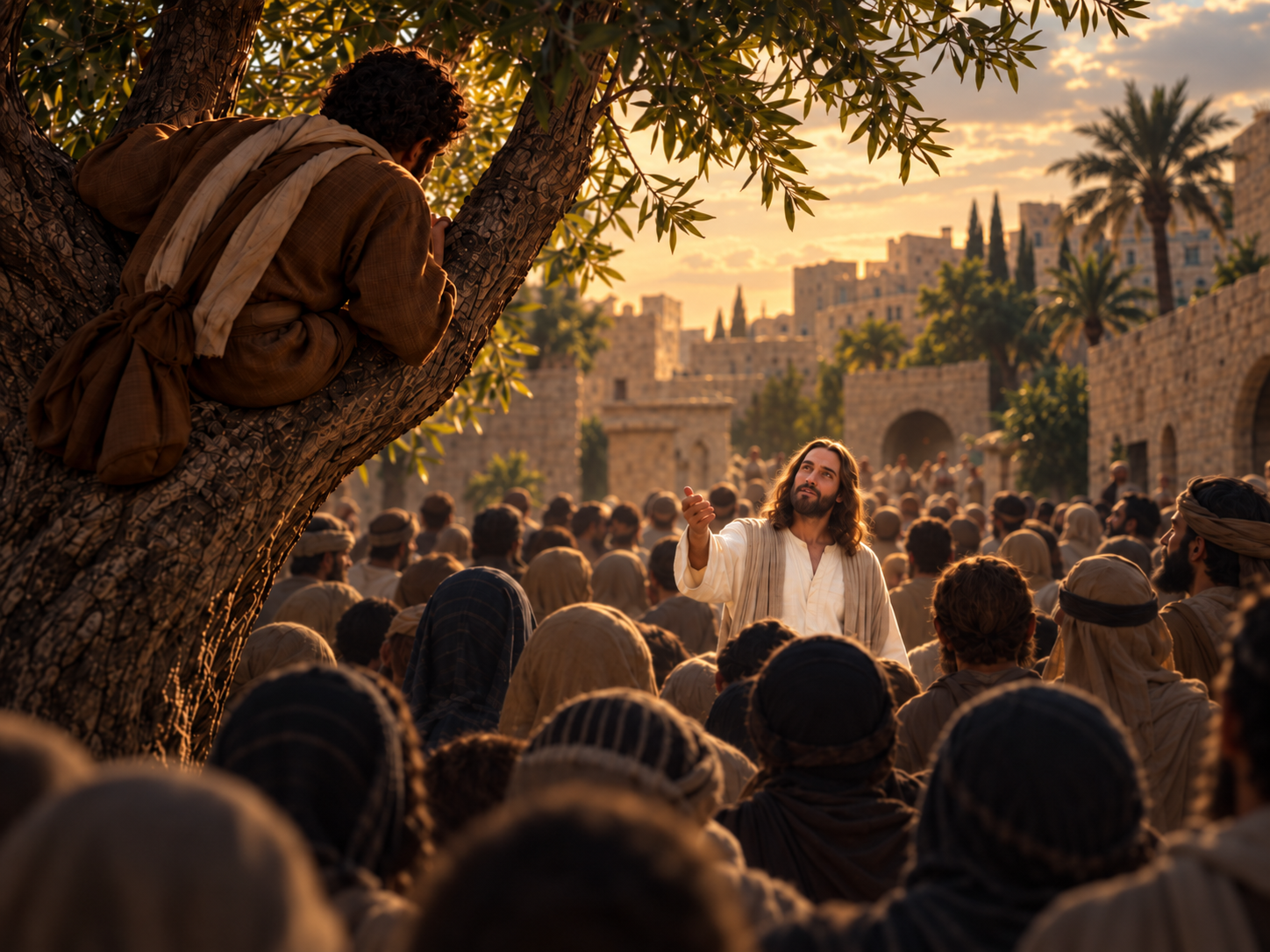
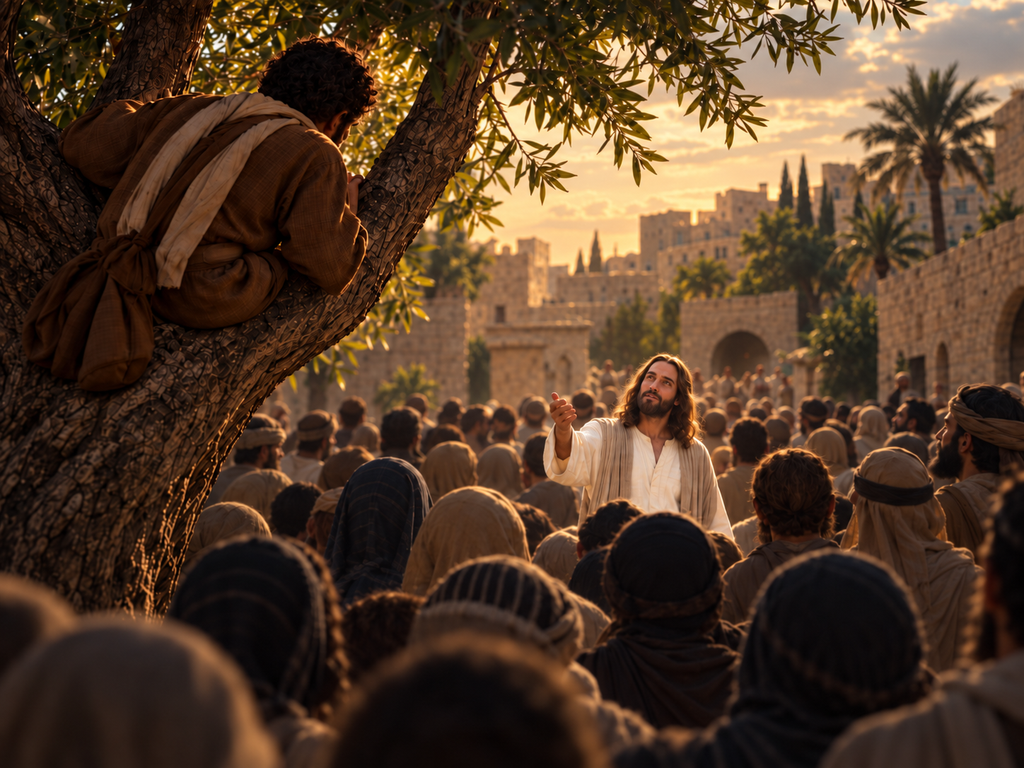
AI-generated illustration.
Picture the street in Jericho. It is noisy, dusty, packed. Zacchaeus is somewhere in that crowd, a tax collector, a collaborator, a man the religious establishment wrote off long ago. He is short. He is not able see the one he yearns to see. And the crowd has closed in front of him.
Not a crowd of Pharisees and priests. Ordinary people, the kind of people who fill any street in any town, people who had their own struggles and their own sins and their own distance from God. But they had decided, without much reflection, that whatever was happening around Jesus was not for someone like Zacchaeus. They were closer to respectable than he was. They deserved to be nearer to Jesus than he did. And so, without anyone making a formal decision, he ended up at the back.
This is not a peculiarly ancient failure. It is recognisable in any gathering of religious people in any century. The human instinct to protect proximity to the sacred, to form a queue and guard one’s place in it, to ensure that the spiritual goods on offer flow first to those who already consider themselves deserving, is not a failure of the obviously wicked. It is a failure of ordinary people who have become, quietly and without noticing, more interested in their own religious experience than in whether others can get through.
So Zacchaeus runs ahead and climbs a tree. And Jesus stops beneath it, looks up, and says: come down, for I must stay at your house today (Luke 19:5). Not at the house of the serious ones. Not at the house of those who had jostled their way to the front. At the house of the man the crowd had, without malice and without much thought, simply blocked.
The crowd is appalled. He has gone to be the guest of a sinner. They had it exactly backwards, and the reason they had it backwards was not simply self-righteousness. It was something deeper. The image of God available to them had been quietly and thoroughly distorted. The shepherds of Israel had for generations been muddying the water people depended on to know who God actually is.
Ezekiel had named this centuries before. In chapter 34, God delivers one of the most devastating indictments in all of Scripture, not against foreign enemies, but against Israel’s own leaders: Is it not enough for you to drink clear water? Must you also muddy the rest with your feet? Must my flock feed on what you have trampled and drink what you have muddied? (Ezekiel 34:1819).
The shepherds had made the water undrinkable. They had made the pasture inaccessible. And in doing so they had made God himself seem like someone he is not, distant, discriminating, available only to those with position and standing. The flock drank the muddy version and mistook it for the real thing.
By the time Jesus walked into Jericho, most people in that crowd had absorbed, without knowing it, a picture of God that bore more resemblance to their own hierarchies than to anything the prophets had actually said.
And so when Jesus stopped beneath a sycamore tree and invited himself to dinner with a tax collector, he was not simply being kind to an outcast. He was showing everyone watching exactly who God is and who he seeks. The scene is a living correction of the distorted image. Clear water, running again, and the crowd standing around it, still not sure they want to drink.
To understand why that correction required such careful preparation, you have to understand what four hundred years of silence had done to the religious world of Israel. Four centuries without a prophetic voice. The scrolls studied, the rituals maintained, the institutions carefully managed.
And then something began to stir at the Jordan. A man in camel hair, quoting Isaiah, speaking with an authority no one had heard in living memory. The effect on the religious establishment was immediate. They came. If something new was descending from heaven, they intended to be the ones who received it, named it and controlled it. That was their function. That was what centuries of institutional authority had prepared them for.
What they did not understand was that their eagerness was itself part of the plan. God did not send Jesus directly into that charged atmosphere. He sent John first, and the precision of that choice is breathtaking.
John spoke the language the establishment recognised. He moved in categories they understood. He was, from their perspective, exactly the figure they had been waiting for. So they came to the Jordan, certain they were about to be confirmed in everything they already believed about themselves.
John turned on them instead. You brood of vipers. Who warned you to flee from the coming wrath? Produce fruit in keeping with repentance (Matthew 3:7–8).
He drew them in and refused to give them what they came for. And while the religious establishment stood at the Jordan arguing and demanding, the tax collectors and soldiers and ordinary people of the land received simple and dignified answers. Share your food. Do not extort. Be content with your pay (Luke 3:10–14).
No gatekeeping. No credentials required. God had used the establishment’s own hunger for the supernatural as a lightning rod, holding them at the Jordan, and clearing the path for everyone else to find their way to Jesus.
This is a demonstration of a divine intelligence that works not against human nature but through it, bending even pride and self-certainty into instruments of grace.
The same troll that lives in all of us, the instinct to get there first, to secure the best position, to think of ourselves before we think of anyone else, appears again on the hillside where Jesus feeds the crowd.
These are not Pharisees and priests. They are ordinary hungry people, and the human logic of scarcity is pressing in on all of them. Two fish and five loaves between thousands, and every instinct says: move forward, get yours while there is still some left, do not trust that there will be enough.
Jesus does something entirely unexpected. He tells them to sit down in groups. He takes the bread, gives thanks, and breaks it. And it is enough. More than enough. Everyone eats. Everyone is satisfied.
The kingdom of God does not run on the logic of scarcity. There is no need to be clever or calculating or ruthless about getting to the front of the line, because the one at the front of the line is not hoarding what is his. He is breaking it open and sending it out to the edges.
In Matthew 20, Jesus makes the principle explicit in a parable. Workers hired at dawn and workers hired at the eleventh hour receive the same wage. The all-day workers are furious. They have done the accounting. The kingdom of God does not run on their accounting.
The last will be first, and the first will be last (Matthew 20:16).
The rich young man of Matthew 19, serious and observant and genuinely seeking, cannot release his grip on what his position has given him, and he goes away sad. The disciples ask the only honest question available: who then can be saved? (Matthew 19:25).
The answer is the answer Pentecost will make visible: with man this is impossible, but with God all things are possible (Matthew 19:26).
Joel had seen this door being built centuries before. I will pour out my Spirit on all flesh. Your sons and daughters will prophesy. Your old men will dream dreams, your young men will see visions. Even on my servants, both men and women, I will pour out my Spirit in those days (Joel 2:28–29, Acts 2:17–18).
Not the priests. Not the scholars. The servants, the ones at the very bottom of every hierarchy, the ones the distorted image of God had taught to wait at the back. God names them not as an afterthought but as a central promise. The Spirit will reach precisely those the system placed furthest from the front.
And so it did. The Spirit fell on the upper room without checking credentials. Paul states the consequence with radical clarity. There is neither Jew nor Gentile, neither slave nor free, neither male nor female, for you are all one in Christ Jesus (Galatians 3:28).
In Colossians: Christ is all, and is in all (Colossians 3:11).
Every axis of stratification, ethnic, legal, gendered, cultural, is named and dissolved. Not because the distinctions do not exist, but because none of them determine your access to God.
This is what the crowd in Jericho could not see. They were not malicious. But their seriousness had produced a god in their own image, one who shared their priorities and kept their kind of people at the front.
The real God was already in the tree, waiting for the one who had given up on the queue and found another way to see.
He is not contained by the institutions built in his name. He is not put off by the muddy water the shepherds have made of what was clear. He works through history and around history, finding routes to those who seek him with an honest heart.
There is enough. There has always been enough. The bread breaks, and keeps breaking, and reaches all the way to the edges.
The first shall be last. The last shall be first.
Come, Holy Spirit.