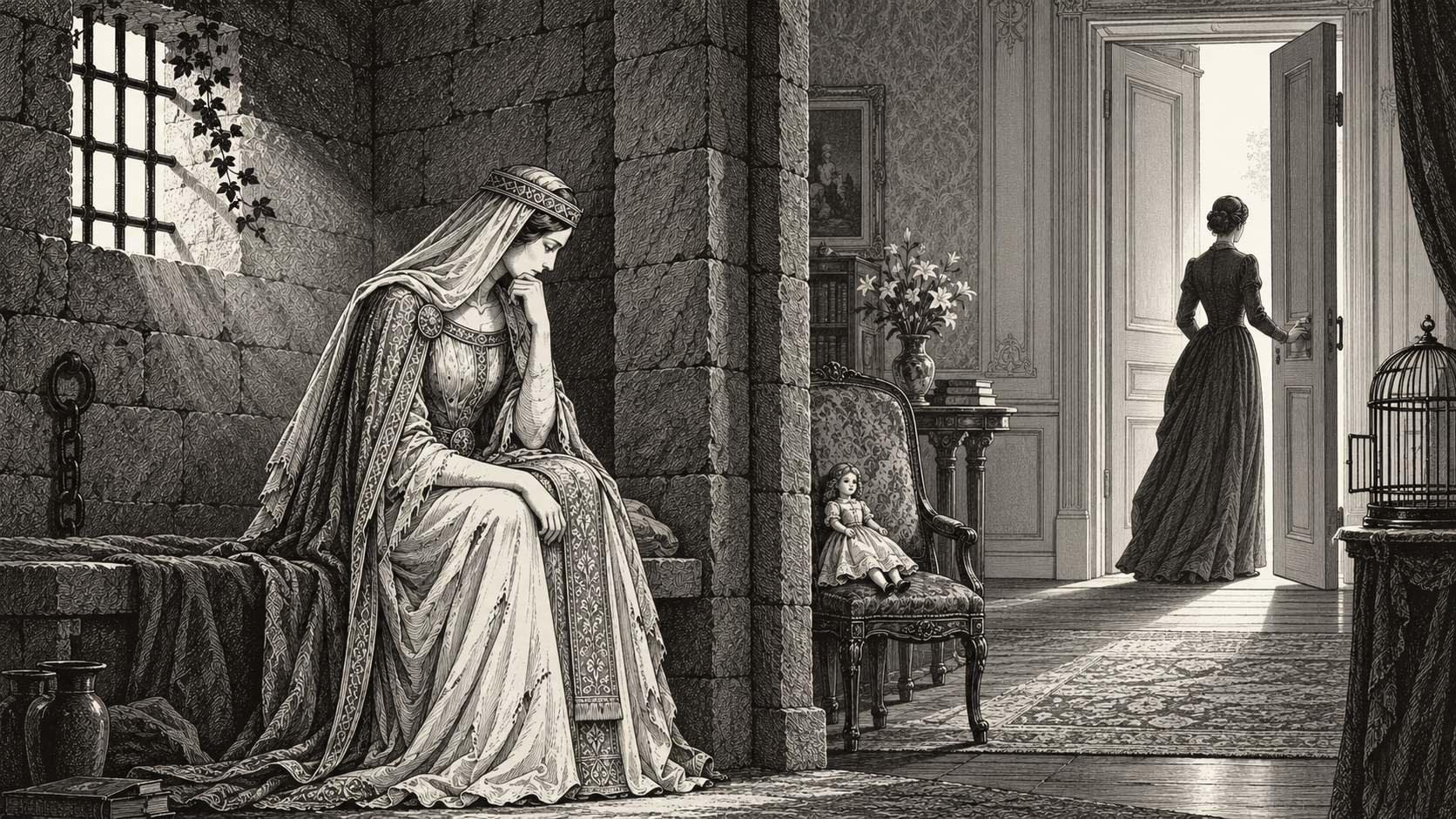
Some stories look modern only because we meet them late. A husband demands obedience. A woman refuses. A society gathers to watch and to judge. We usually hear that story through one name: Nora Helmer, leaving her husband, her children, and the most famous door in modern theatre.
Fourteen centuries earlier, in the imperial borderlands of the Caucasus, a queen and mother of four named Shushanik had already faced the same terrible bargain. Long before Nora reached her door, Shushanik entered a bare cell beside a church. Her story is the earliest surviving works of Georgian literature — and one of the sharpest early texts we have about dignity, coercion, and the price a woman pays when she refuses to let her husband determine the borders of her soul.
Nora’s the one we remember. Her exit has been canonized ten thousand times over — the birth of the modern woman, the arrival of individual freedom into the bourgeois home, the moment a wife stops being a doll and becomes a person. That closing door has become one of theatre’s defining sounds..
This essay is not about the door. It is about the silent cell that came first.
Among the Christian cultures of Late Antiquity that wrote in their own languages, Georgian and Armenian literature occupy an unusually early place: by the fifth century, both already possessed fully formed literary works in the vernacular. But the neighborhood was merciless. The Caucasus stood between empires, and what those empires did not absorb, they often erased. Caucasian Albania — an entire Christian culture in what is now Azerbaijan, with its own alphabet — survives today only in fragments, most famously in palimpsests. Georgia escaped that fate, but barely. Its medieval Golden Age under King Tamar — a woman who ruled under the title of king from 1184 to 1213 — ended when the Mongols arrived, and for the following centuries Georgian manuscripts burned in wave after wave of Mongol, Persian, Ottoman, and Russian invasion. The first printing house inside Georgia opened in Tbilisi only in 1709, more than two hundred years after Gutenberg’s neighbors had set up their presses. War, fire, isolation, and chance left us only flashes in the dark: texts whose authors we often cannot name, whose schools we can only guess at. What survived is the most important thing — the works themselves.
The Martyrdom of Saint Shushanik, the Queen is one of them. The title, rather mercilessly, gives away the ending. This is hagiography — martyr literature — and historians broadly agree it is based on real events. The conflict is simple but devastating. Shushanik’s husband, Varsken breaks with the Christian political order of Kartli and aligns himself with the Sasanian Persian world. To win the Shah’s favor he converts and promises to convert his family too. He returns from Persia with a new bride — and since his new religion permitted polygamy, he fully expects Shushanik to accept the arrangement, change her faith, and become one of his wives.
From the beginning, Varsken’s violence is not only physical. It is existential. He decides on Shushanik’s behalf what her faith will be, what her marriage will mean, what her children’s future should become, and what place she will occupy in his reorganized world. He consults her on nothing. He behaves as if her consent belongs to him already.
Here a confession of method is needed, because it determines everything that follows.
For fifteen centuries, The dominant tradition has read Shushanikthrough the hagiographic lens — and the lens is legitimate, since the text was written by Jacob of Tsurtavi, a priest, in a genre whose entire purpose is to produce a saint. Naturally he sanctified her; naturally her own thinking was deeply Christian. But genre is a frame, not a cage. Behind the saint stands a human being: a queen, a wife, a mother of four, a woman of enormous rank and pride whose husband erased her without asking. To read her psychologically is not to strip away her faith. It is to refuse to strip away her humanity. She was not a nun who had renounced the world; she was a queen, with a queen’s dignity, and that dignity was trampled in the most intimate way possible — by the man who shared her bed, in front of the household she had ruled. The hagiographic frame has held her so long that we have forgotten to ask the simplest question about her: what did it feel like to be this woman? The moment we ask it, Shushanik stops being a relic. And she begins, unexpectedly, to approach Nora.
For many Georgian readers encountering Ibsen, the connection is almost instantaneous, triggered by a single element: the children. Shushanik has four; Nora has three. For both women, the moral conflict with the husband passes directly through the children, and the audience — ancient and modern alike — judges them through the lens of motherhood.
Even though the Martyrdom is a brief, ancient text, the dilemma is articulated with surprising sharpness. When Shushanikwithdraws, she prays:
“Now, I think nothing of these [children], who are physically born of an impious man — mortals born of a mortal. Now, my Lord, if you consider them to be worthy of remaining in [their state of] rebirth in the Father, the Son and the Holy Spirit, keep them true to the right faith and to good works, so that they may live on earth with self-control.”
— The Martyrdom of Shushanik
Fourteen centuries later, Nora Helmer faces her own cross-examination:
HELMER: Do I need to tell you that? Are they not your duties to your husband and your children?
NORA: I have other duties just as sacred.
HELMER: That you have not. What duties could those be?
NORA: Duties to myself.
— A Doll’s House, Act III
Duties to myself. The phrase is usually read as the birth-cry of secular individualism — which makes it sound impossibly distant from a fifth-century martyr. But look at what duty to oneself actually means inside Shushanik’s world.
In Christian thought, there is one thing no person may surrender to another — not to a husband, not to a king, not even to a parent: the care of their own soul. Salvation is not collective property. Each soul answers for itself, before God, alone. Shushanik herself invokes Paul in the Martyrdom: “A brother or sister is not enslaved. ” When she refuses to apostatize, she is performing, in theological vocabulary, something strikingly close to what Nora names in secular vocabulary: a duty to herself — to her own soul — that outranks every duty imposed from outside. Her conscience is not Varsken’s to command, and not even her children’s to claim.
And she extends the same terrible logic to her children. She does not hand them to Varsken, and she does not chain them to herself either. She entrusts them to God — which is to say, she leaves their souls where her faith insists every soul must finally stand: alone before God. When Varsken later turns them toward his new religion, that hope is shattered. Shushanik weeps bitterly and says: “They were not mine, but Yours, given to me. As You will, let Your will be done. ” This is not indifference, and still less religious neutrality. She wants them to remain Christian and suffers when they do not. But she relinquishes possession without relinquishing conviction. She will not buy them back at the price of her own soul. The vocabulary is theological; the scandal is Nora’s.
That scandal is still alive. Even today, some conservative voices in Georgian education criticize Shushanik for abandoning her children — fifteen centuries after her death, she is still being judged as a mother. This is not a side detail of the comparison; it is its center. Shushanik disturbs readers not only because she defies her husband, but because she refuses to let motherhood become the final argument against conscience. So does Nora. That refusal is precisely what made audiences walk out of Ibsen’s play in 1879, and what keeps both women on trial today.
Once the hagiographic drapery is set aside — momentarily, respectfully — what we find at the heart of both stories is not simple anger. It is the violation of dignity.
A violation of dignity occurs when a person is treated as less than a moral subject — when their conscience, consent, intelligence, or inner life is treated as irrelevant. It creates a wound deeper than ordinary disappointment: the experience of being reduced from person to role, from voice to obedience, from soul to function. Nora is reduced to wife, mother, child, decoration. The moment Torvald reads Krogstad’s letter, he sees not the sacrifice that nearly ruined her, but scandal, damage, embarrassment — and in a single scene the marriage reveals its true structure. Shushanik is reduced further still: to wife, convert, political token, obedient body, living proof of her husband’s loyalty to another empire. In both cases the husband’s power does not merely command action. It attempts to define identity.
That is why their refusals are so radical. They are not reacting only to bad husbands. They are reacting to worlds that have made obedience the price of belonging. To remain would mean more than compromise; it would mean accepting the version of themselves produced by male authority — living on as someone else’s sentence. And here the indignity produces an unexpected inversion: pushed past a certain threshold, humiliation stops paralyzing these women. It makes them immovable.
The body reveals this before the final separation does.
In Shushanik’s story, one of the most striking scenes takes place at a meal. Not a grand public banquet — a small, tense domestic arrangement: Varsken, his brother Jojik, Jojik’s wife, and Shushanik. The smallness makes it more suffocating, not less. There is nowhere to hide, no ceremonial distance, only family pressure gathered around a table. Jojik’s wife offers Shushanikwine. The gesture seems ordinary, even gentle, but inside the story it is loaded with violence. The cup is not only a cup. It is an invitation to re-enter the order Varsken controls, to soften her refusal, to let the family absorb her resistance and call it peace.
Shushanik throws the cup back.
The gesture is small in size, enormous in meaning. She rejects not just the wine but the whole performance surrounding it — the meal, the persuasion, the honeyed words, the false domestic calm, the attempt to make her surrender look like reconciliation. Her hand says what polite speech cannot: I will not bless the world that is destroying me.
Nora’s tarantella plays a similar role. Torvald wants beauty, charm, performance — the wife who dances under his instruction, the living ornament of his home. Instead Nora dances frantically, almost unbearably, as if her very survival hangs in the balance. The dance no longer belongs to the polished theatre of domestic happiness; her body begins to reveal the panic hidden beneath the marriage’s decorative surface.
These scenes are not irrational outbursts. They are embodied protest. Neither in fifth-century Caucasia nor in nineteenth-century Norway did a woman’s verbal argument carry legal or social weight against male authority — and when words are systematically rendered powerless, the body becomes the place where truth appears. Shushanik’s hand refuses the cup before the household can swallow her back into obedience. Nora’s dance tears through the graceful image Torvald has made of her before her final speech gives that rupture language. In both works, the female body interrupts the script written for it.
This is where a careful Brechtian reading may be useful — though not because every powerful movement is automatically “Brechtian.” In Brecht’s theatre, a physical action can expose a social relation: it can show, in one concentrated moment, the structure of power that ordinary dialogue hides. Shushanik’srejection of the wine and Nora’s tarantella work in that sense. The gesture does not merely express emotion. It reveals the world.
The comparison also asks us to look again at Ibsen himself. A Doll’s House is often treated as a feminist landmark, and it certainly became one — Ibsen’s own working notes say plainly that a woman cannot be herself in a society made by men, with laws written by men. But Ibsen famously resisted being claimed as a propagandist for any movement, and to read Nora only as a feminist emblem is to make him smaller than he is. Before Nora, his greatest works — Brand, Peer Gynt, Emperor and Galilean— were dramas of conscience, faith, vocation, and the uncompromising cost of remaining true to oneself. The play is feminist in its consequences; its engine, however, belongs to that older and deeper drama. Nora’s “duties to myself” is not a political slogan. It is an ethical rupture — the discovery that wifehood and motherhood, as Torvald understands them, require her to go on living inside a lie.
Seen from this angle, Shushanik is not Nora’s opposite. She is her ancient relative.
Not her predecessor in a direct literary sense — there is no need to invent influence where none has to be proven. Ibsen never read Shushanik, and a fifth-century martyr does not secretly anticipate modern feminism. The point is more interesting: two radically different literary worlds discovered the same human crisis. The home can become a theatre of domination. Obedience can be demanded in the name of love, religion, respectability, or order. And a woman’s refusal becomes most scandalous precisely when it exposes the moral poverty of the system judging her.
Still, the two women should not be forced into sameness. Nora leaves in order to discover who she is outside the roles assigned to her; Shushanik withdraws in order to remain faithful to what she already knows she is. Nora’s movement is toward self-education, Shushanik’s toward martyrdom. One exits the home; the other enters confinement. One chooses an unknown future; the other, a known suffering.
But at the deepest point, their gestures meet. Each woman reaches the limit beyond which endurance would become self-betrayal. Each refuses to continue living inside a structure that requires her own disappearance.
This matters especially for readers who know Nora well. Nora has become so familiar that she is sometimes softened by fame. We know the door will slam. We know the speech will come. We know she will leave. The shock has become part of cultural memory.
Shushanik restores the shock.
She reminds us that the drama of female dignity did not begin in the modern European living room. It also existed in the prison cell, the palace, the church, the dining room, the borderlands of empire — in languages and literatures that world culture still too often treats as peripheral. It existed in Georgia, in the fifth century, in a text that deserves to be read not as a museum relic, but as a work of terrifying psychological and literary force.
Nora’s door is loud because modern Europe learned to hear it.
Shushanik’s cell is quieter. But it came fourteen centuries earlier — and if we listen carefully, it contains the same sound: the moment when a woman refuses to let power finish the sentence for her.