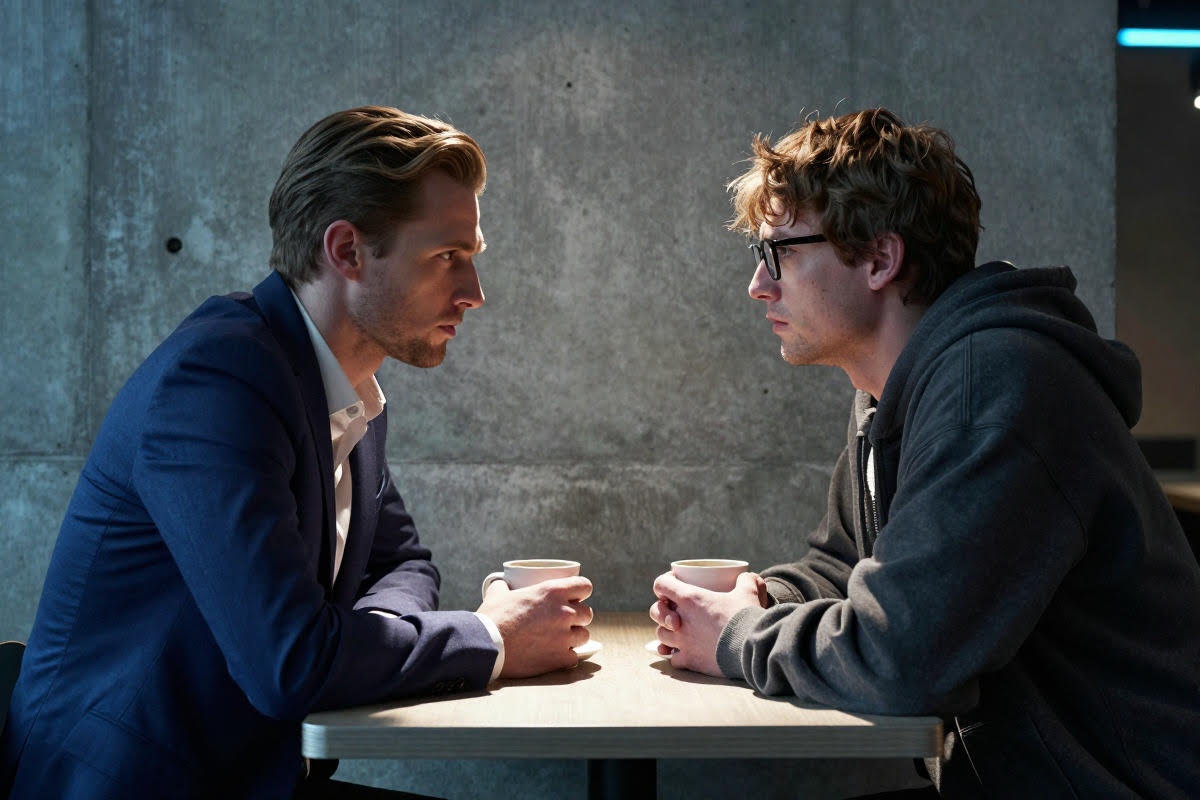
I am sitting in a downtown café that looks as if it were designed by a minimalist in the depths of a clinical depression: raw concrete walls, neon lighting, and coffee priced like a three-course meal in the provinces. Around me is the sterile world of biotech. My backpack is stuffed with dossiers on startups promising to defeat death or, at the very least, make it more aesthetically pleasing. I’ve just come from another meeting. We discussed “innovative development vectors” and “the scalability of solutions.” In this world, everything is packaged in glossy presentations where human health is represented as a series of elegant growth charts. But the truth is that we are all simply trying to negotiate with a biology ruled by entropy.
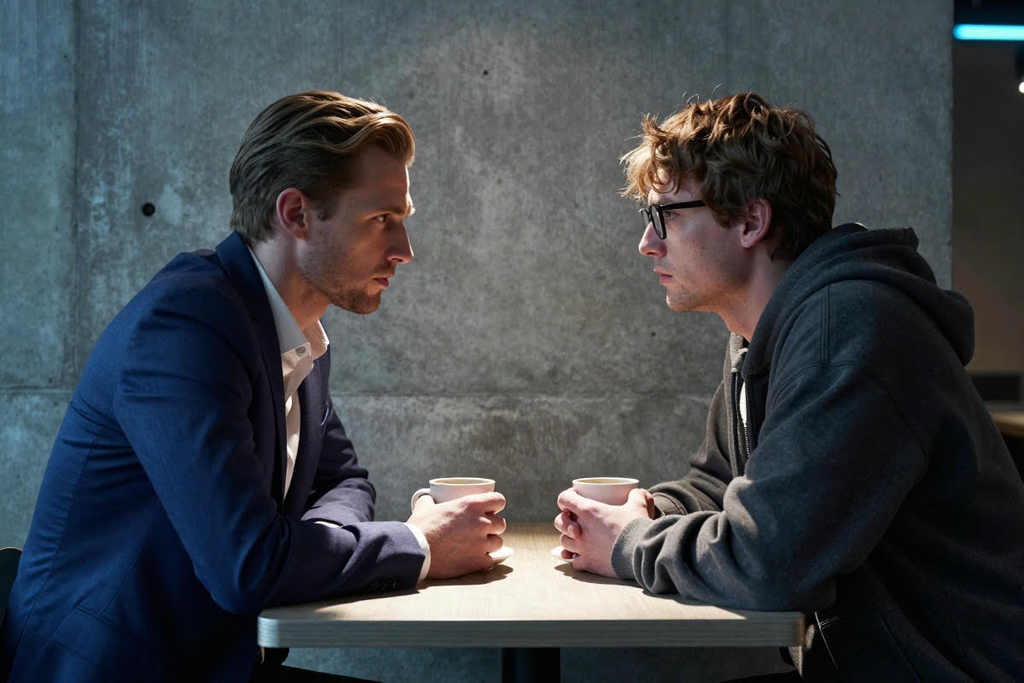
At the next table, a little social catastrophe is unfolding. Or rather, what is known in the modern world as a “reunion of old friends.” Two men. One is wearing a flawless navy blazer that practically screams “traditional values” and confidence in the tomorrow. The other is in an oversized hoodie, with an expression suggesting he has just read the entire library of critical theory and is now profoundly disappointed in the very existence of matter.
Perhaps they haven’t seen each other for quite a while. The first ten minutes are the classic ritual of social exchange: who works where, who divorced whom, who moved cities. But the air between them begins to vibrate. It is that specific tension that arises when two people realize they no longer inhabit the same reality, despite speaking the same language.
The escalation is slow, almost seductive. It begins with nostalgia, a few shared memories of a youth spent before the world fractured. But then, the cracks appear. A comment about a recent election, a subtle jab at a choice of career, a misplaced smile.
— “I saw your last post on LinkedIn,” the Blazer says, his voice dripping with a polite, poisonous curiosity. “Still championing the cause of the ‘marginalized’ from the comfort of a climate-controlled office? It’s a charmingly quaint perspective.”
The Hoodie doesn’t flinch. He leans back, a thin, acidic smile playing on his lips. — “And I saw your endorsement of the new tax bill. I didn’t realize you’d fully transitioned into the role of a corporate cheerleader. Tell me, does the blazer come with a complimentary set of blinders, or do you buy those separately?”
They are no longer talking about their lives; they are testing the fences of their respective ideologies. The conversation shifts from the personal to the systemic. They begin to use the “scripts” — those narrative formulas that clog our social media feeds.
— “It’s about personal responsibility,” the Blazer asserts, his voice gaining a sharp, rhythmic edge. “The world operates on the laws of the market, my friend, not on Twitter threads and wishful thinking.”
— “The market?” the Hoodie parries, his tone now openly mocking. “You call a ‘market’ a system that systematically oppresses the vulnerable and drains the future to line the pockets of a few aging patriarchs? This isn’t a market; it’s a simulacrum of progress.”
Sipping on my cooled-down matcha, I quietly observe this public tennis match where, instead of a ball, cleverly spun ideological clichés from the most viral social media pages fly around with increasing acceleration.
— “Institutional stability!” shouts one. — “Systemic failure!” retorts the other. — “Traditional values!” — “Toxic masculinity and institutionalized hegemony!”
They are no longer speaking to each other. They are speaking to the ghosts of their political opponents, caricatures they have carefully curated in their minds. This is the modern tragedy: we have stopped seeing people; we only see “markers.”
Suddenly, the Blazer snaps. His voice breaks, losing its polished edge, revealing a raw, unscripted agony: — “Responsibility? To hell with responsibility! When my state, my taxes, and this entire f***ing partisan war can’t give my mother a cure for Alzheimer’s! She is forgetting my name while you sit here arguing about which color curtain in the White House is more inclusive!”
The silence that hung in the air was instant, as if a magnetic tape of a Led Zeppelin recording had suddenly snapped. It was a physical silence, like a slap. The ideological armor disintegrated into dust. The Hoodie slowly lowered his gaze to his cup. His face transformed. The sarcasm vanished, replaced by a vulnerability that the oversized hoodie could no longer hide.
— “My father…” he said softly. “Parkinson’s. I have the money. I can buy every gadget in this city, but I cannot buy him a steady hand.”
And here is the moment of truth. The only honest moment in this concrete café.
They sit across from one another — two representatives of warring camps, two soldiers in an information war — and suddenly realize that they are bound by something far more powerful than any political platform. They are united by a shared fragility in the face of biological decay.
They remained silent for a long time. I could see the walls crumbling. All that anger, all that fury they had cultivated for years by reading different echo chambers, turned out to be nothing more than noise. Expensive, exhausting, useless noise. They spend their best years hating each other over state budgets, while those very budgets could be spent ensuring their parents don’t vanish from their lives prematurely. We fight over symbols while reality devours us alive.
— “Another coffee?” one asked quietly. — “Yeah. Let’s have one more,” the other replied.
The conversation shifted gears. It became slow, tentative, laced with notes of remorse. There was no longer a desire to win an argument; there was only a desire to be heard. They agreed to meet in the park next weekend. Just to walk. No phones. No politics.
I didn’t wait for the finale. At that moment, the rain stopped, and the sun hit the café windows, turning the grey concrete into something resembling gold. I gathered my backpack of “innovative solutions” and stepped outside. I squinted against the sudden glare and breathed in the damp, fresh air.
In a world where everything is sold, bought, and packaged into political slogans, believing in people is the boldest and most insane act of all. But I choose to believe. After all, we are all just fragile protein structures desperately wanting to be loved. And perhaps, in the end, that will be the only solution to all our global problems.